Most men I photograph arrive having looked up posing tips beforehand. Which means most of them arrive ready to do the same three things: cross their arms, look into the middle distance, and lean against something. These aren't wrong exactly. But they're also what everyone else is doing — and on a dating app, looking like everyone else is the problem you're trying to solve.
The bigger issue is that posing advice for men is usually written for editorial or fashion photography, which has completely different goals. A fashion photo is trying to sell clothes. A dating profile photo is trying to answer a specific question: is this someone I want to spend time with? Those require different things from the body.
The bigger issue is that posing advice for men is usually written for editorial or fashion photography, which has completely different goals. A fashion photo is trying to sell clothes. A dating profile photo is trying to answer a specific question: is this someone I want to spend time with? Those require different things from the body.
The one posture mistake that shows up in almost every man's photos.
Standing square-on to the camera — feet together, shoulders parallel to the lens — makes most men look wider and more defensive than they are in real life. It's the instinctive position people adopt when they don't know what else to do with their body, and it reads on camera as exactly that.
The fix is simple: turn your body about thirty degrees away from the camera, put your weight on your back foot, and let your front shoulder drop slightly forward. This creates depth in the photo, makes the shoulders look narrower and more relaxed, and adds a quality that reads as at ease rather than braced.
You don't need to think about this as a pose. Think of it as how you'd stand if you were having a conversation with someone you'd just met at a party — engaged, but not at attention.
Standing square-on to the camera — feet together, shoulders parallel to the lens — makes most men look wider and more defensive than they are in real life. It's the instinctive position people adopt when they don't know what else to do with their body, and it reads on camera as exactly that.
The fix is simple: turn your body about thirty degrees away from the camera, put your weight on your back foot, and let your front shoulder drop slightly forward. This creates depth in the photo, makes the shoulders look narrower and more relaxed, and adds a quality that reads as at ease rather than braced.
You don't need to think about this as a pose. Think of it as how you'd stand if you were having a conversation with someone you'd just met at a party — engaged, but not at attention.
Using the environment without looking like a catalogue.
Leaning against something — a wall, a railing, a doorframe — is useful because it gives the body a reason to be in a particular position, which removes some of the self-consciousness. The problem is when it's done too deliberately. A lean that's thought about looks like a lean. A lean that comes from actually resting against something looks natural.
The practical version: walk up to the wall, actually put your weight against it, then adjust slightly. Don't place yourself against it from a distance and hold the position. Let the surface support you first, then we take the photo.
Sydney has excellent surfaces for this — the sandstone at The Rocks, the brick laneways in Surry Hills, the railings along Barangaroo. The location becomes part of the image rather than just a backdrop, which is one of the reasons I prefer shooting on location over studios for dating photos.
Leaning against something — a wall, a railing, a doorframe — is useful because it gives the body a reason to be in a particular position, which removes some of the self-consciousness. The problem is when it's done too deliberately. A lean that's thought about looks like a lean. A lean that comes from actually resting against something looks natural.
The practical version: walk up to the wall, actually put your weight against it, then adjust slightly. Don't place yourself against it from a distance and hold the position. Let the surface support you first, then we take the photo.
Sydney has excellent surfaces for this — the sandstone at The Rocks, the brick laneways in Surry Hills, the railings along Barangaroo. The location becomes part of the image rather than just a backdrop, which is one of the reasons I prefer shooting on location over studios for dating photos.
The look-away, done properly.
Looking away from the camera is genuinely useful — it creates a different quality to the image than direct eye contact, and it gives the viewer the experience of catching someone in a private moment rather than being photographed at. But most people do it wrong.
The mistake is looking away and then holding still, waiting. This produces the same stiffness as looking directly at the camera — just pointed in a different direction. The look-away works when there's something to actually look at, or when it's part of a movement rather than a held position.
I'll often ask someone to watch something happening nearby — a boat on the harbour, a person walking past, a specific building. The slight genuine interest that comes from actually looking at something real produces a completely different expression than staring at a blank patch of wall because I told you to look that way.
Looking away from the camera is genuinely useful — it creates a different quality to the image than direct eye contact, and it gives the viewer the experience of catching someone in a private moment rather than being photographed at. But most people do it wrong.
The mistake is looking away and then holding still, waiting. This produces the same stiffness as looking directly at the camera — just pointed in a different direction. The look-away works when there's something to actually look at, or when it's part of a movement rather than a held position.
I'll often ask someone to watch something happening nearby — a boat on the harbour, a person walking past, a specific building. The slight genuine interest that comes from actually looking at something real produces a completely different expression than staring at a blank patch of wall because I told you to look that way.
Movement produces better photos than poses do.
The photos that look most natural are almost never taken when someone is holding a position. They're taken in the half-second of transition — walking and turning, sitting down, standing up, reaching for something.
This is why I often ask people to walk towards me and then stop, or to turn away and then turn back. The stopping point is the photo. The walk is just getting the body into a state where it isn't performing.
If you're shooting on your own: take photos in short bursts rather than one at a time, and look at the ones that happen between your deliberate poses. The series of three where the first is slightly blurry because you moved and the third is the one you were going for — look at the second one. That's usually the best shot in the sequence.
The photos that look most natural are almost never taken when someone is holding a position. They're taken in the half-second of transition — walking and turning, sitting down, standing up, reaching for something.
This is why I often ask people to walk towards me and then stop, or to turn away and then turn back. The stopping point is the photo. The walk is just getting the body into a state where it isn't performing.
If you're shooting on your own: take photos in short bursts rather than one at a time, and look at the ones that happen between your deliberate poses. The series of three where the first is slightly blurry because you moved and the third is the one you were going for — look at the second one. That's usually the best shot in the sequence.
What to do with your hands.
Hands are genuinely difficult. They're the thing most men mention when they talk about feeling awkward in photos — 'I never know what to do with them.' The answer isn't a specific position; it's occupation.
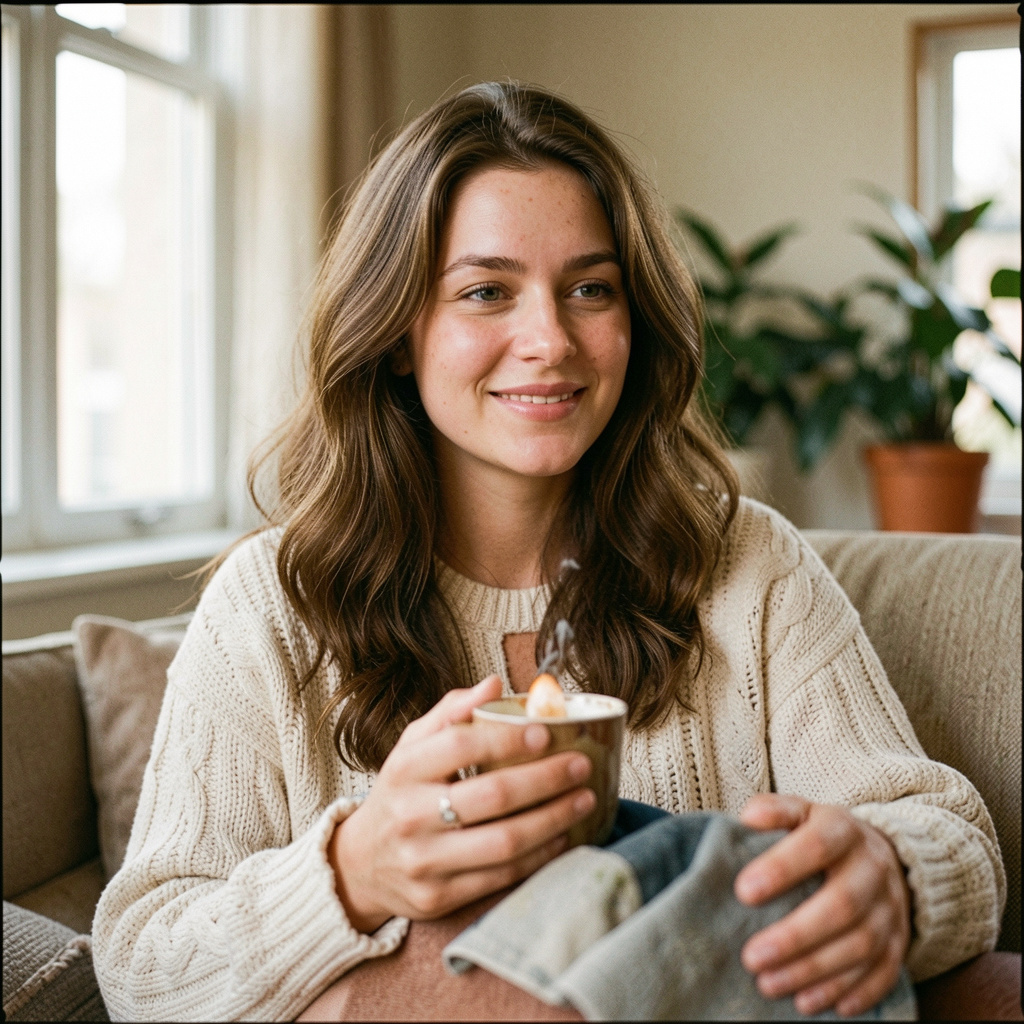
Hands that are doing something — holding a coffee, in a pocket, loosely around a glass, resting on a surface — look fine. Hands that are hanging at the sides doing nothing tend to look like they're aware of being photographed.
One pocket is usually fine. Both pockets looks slightly awkward. Arms crossed is usable but reads as closed-off depending on how it's done. The most natural hand position is usually the one that comes from the environment — sitting at a table, standing at a bar, leaning against something your hand can rest on.
If none of those apply and you genuinely don't know what to do: one hand loosely in one pocket, other arm relaxed at your side with a very slight bend at the elbow. Not straight down. That small bend removes the stiffness.
If you want to talk through all of this before shoot day, the pre-shoot conversation is exactly what it's for — we work out what you're likely to feel awkward about before the camera comes out.
Hands are genuinely difficult. They're the thing most men mention when they talk about feeling awkward in photos — 'I never know what to do with them.' The answer isn't a specific position; it's occupation.
Hands that are doing something — holding a coffee, in a pocket, loosely around a glass, resting on a surface — look fine. Hands that are hanging at the sides doing nothing tend to look like they're aware of being photographed.
One pocket is usually fine. Both pockets looks slightly awkward. Arms crossed is usable but reads as closed-off depending on how it's done. The most natural hand position is usually the one that comes from the environment — sitting at a table, standing at a bar, leaning against something your hand can rest on.
If none of those apply and you genuinely don't know what to do: one hand loosely in one pocket, other arm relaxed at your side with a very slight bend at the elbow. Not straight down. That small bend removes the stiffness.
If you want to talk through all of this before shoot day, the pre-shoot conversation is exactly what it's for — we work out what you're likely to feel awkward about before the camera comes out.